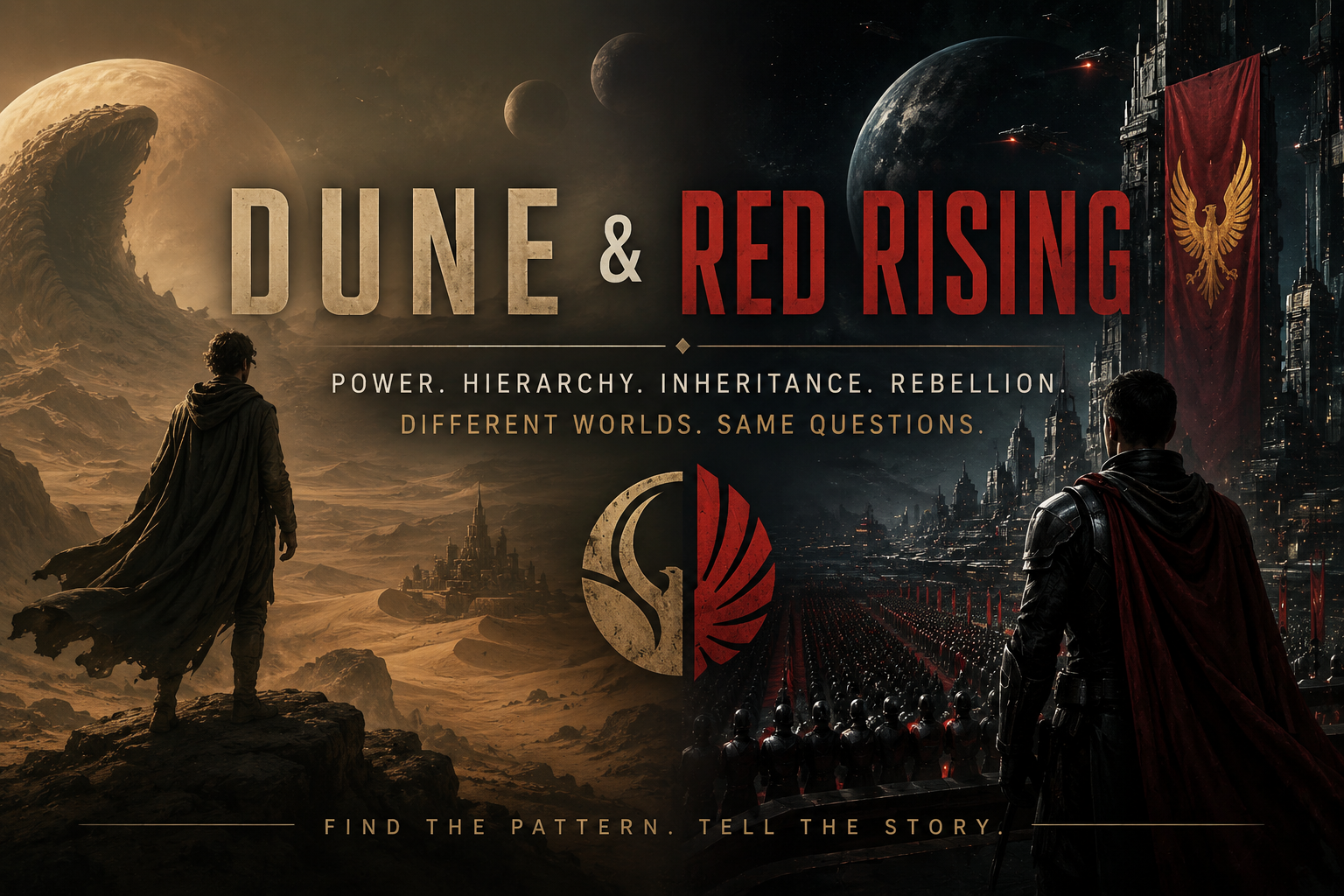
Science fiction is often described as a genre about the future, but its greatest stories are rarely just about technology for the future alone. At their core, many science fiction novels explore power; who possesses it, how it is maintained, and what happens when people decide to challenge it.
Few modern science fiction series examine these questions more effectively than Frank Herbert’s Dune and Pierce Brown’s Red Rising. While separated by decades, both stories place readers inside highly structured societies built upon hierarchy, inherited privilege, and carefully maintained systems of control. Through different settings and characters, they ask many of the same questions:
- Who deserves power?
- Can unjust systems be reformed?
- What is the cost of rebellion?
- Do those who overthrow power inevitably become part of the system they sought to destroy?
Bloodlines and Hierarchy
Both Dune and Red Rising begin with societies organized around inherited status.
In Dune, noble houses govern vast regions of the Imperium. Power is passed through bloodlines, alliances, and political maneuvering. Entire populations live under the authority of families whose positions were established generations before.
Similarly, Red Rising divides humanity into a rigid Color hierarchy. Golds rule. Reds labor. Every person’s place in society is determined before birth.
The systems are different in appearance but remarkably similar in function. Both of them create a stability by assigning individuals predetermined roles. Those at the top benefit from the arrangement, while those at the bottom are taught to accept it as natural.
Frank Herbert understood that power is rarely dangerous because it corrupts good people. More often, it attracts those most willing to wield it. As he famously credited with saying:
“Absolute power does not corrupt absolutely, absolute power attracts the corruptible.”
That observation is clear throughout both series. The ruling classes in Dune and Red Rising do not simply inherit authority; they inherit systems designed to preserve it.
What makes these stories compelling is that neither simply portrays oppression. Instead, they reveal how systems justify themselves. Hierarchies survive not merely because of force, but because people come to believe they are necessary.
This is a pattern that extends far beyond fiction. Throughout history, societies have often presented existing power structures as inevitable, permanent, or even beneficial. Herbert and Brown challenge readers to question those assumptions.
Myth as a Political Tool
One of the most fascinating similarities between the two series is how they explore the relationship between power and myth.
In Dune, prophecy becomes a political weapon. The Bene Gesserit spend generations planting religious beliefs across worlds, creating stories that can later be used to influence entire populations. Paul Atreides ultimately steps into a role shaped by those myths and discovers that belief can be more powerful than armies.
In Red Rising, the ruling Golds construct their own mythology. They portray themselves as superior beings destined to lead humanity. Their authority rests not only on military strength but on a carefully cultivated narrative about who deserves to rule.
Both stories recognize an uncomfortable truth, which is people rarely follow power alone. They follow stories.
Leaders who can shape those stories often gain influence far beyond what force can achieve. Whether through religion, ideology, tradition, or culture, narratives help determine what societies view as legitimate.
The lesson is not confined to fictional empires. Human history is filled with examples of nations, institutions, and movements built upon stories that gave meaning to existing power structures.
Rebellion and Its Cost
At first glance, both series appear to tell familiar revolutionary stories.
Paul rises against those who destroyed House Atreides.
Darrow fights to break the Color hierarchy.
Yet neither author presents rebellion as simple or clean.
One of the defining phrases of Red Rising is,”Break the chains.”
The words capture the moral clarity that often fuels revolutionary movements. When injustice becomes visible, resistance can feel not only justified but necessary.
Yet Brown repeatedly demonstrates that overthrowing a system is often easier than replacing it. Every victory carries consequences. Every sacrifice leaves scars. Every revolution creates new questions about who should lead and how power should be used.
Herbert explores a similar tension in Dune. Paul’s victory unleashes forces he cannot fully control. The revolution succeeds, but success creates new dangers. The story continually asks whether changing rulers truly changes the system.
Perhaps Herbert’s most unsettling observation about power is this:
“When I am weaker than you, I ask you for freedom because that is according to your principles; when I am stronger than you, I take away your freedom because that is according to my principles.”
This quote should serve as a warning that power can reshape ideals as easily as it reshapes governments. Both Dune and Red Rising challenge readers to consider whether any system is immune from that temptation.
Why We Connect with Power Struggles
The enduring popularity of Dune and Red Rising reveals something important about science fiction readers.
Most readers are not drawn to these stories because of spaceships, advanced technology, or distant planets. They are drawn to the human questions hidden beneath those settings.
Everyone exists within systems they did not create. Families pass down traditions. Organizations develop cultures. Governments establish institutions. Communities create expectations. We inherit structures, assumptions, and rules long before we understand them.
Stories about power resonate because they reflect a universal human experience. We all encounter systems that shape our lives. We all face questions about responsibility, authority, fairness, and change.
Science fiction simply magnifies those questions by placing them in extraordinary worlds.
Pierce Brown captures this idea through one of the recurring themes of his work:
“The measure of a man is what he does when he has power.”
That question sits at the center of both series. Not who gains power. Not who loses it. But what people choose to do once they possess it.
Final Thoughts
Both Dune and Red Rising demonstrate why science fiction remains one of the most powerful tools for examining human nature.
Their worlds may be fictional, but the patterns they explore are real. Power concentrates. Hierarchies emerge. Stories justify authority. Rebellions challenge existing systems. Yet, every generation must decide whether to preserve the structures it inherits or attempt to build something new.
That is why these stories endure. They are not really about the future. They are about us. As readers, we may never rule an empire, command a great house, or lead a revolution across the solar system. Yet the questions these stories ask remain deeply personal:
- What systems have we inherited?
- Which deserve to be preserved?
- Which deserve to be challenged?
- When power finds its way into our hands, what kind of people will we become?